

Key Points:
- Technological Displacement: Argues that computers, robotics and telecommunications are replacing workers across agriculture, manufacturing and services faster than new jobs are created.
- No New Sector to Absorb Labor: Unlike earlier transitions, from farms to factories to offices, the information age offers no large new sector to absorb displaced workers.
- Social Consequences: Warns of rising inequality, a shrinking middle class and social unrest as the benefits of productivity flow to a narrow knowledge elite.
- The Third Sector: Proposes shorter work weeks and investment in the civil society or “third sector” (community and nonprofit work) as a new source of meaningful activity.
Summary:
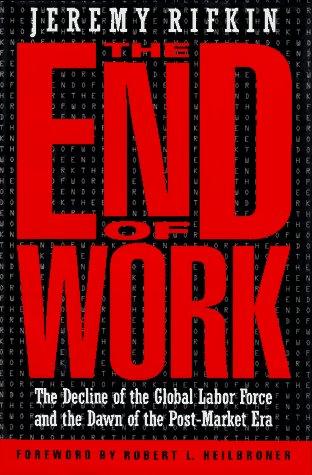
“The End of Work: The Decline of the Global Labor Force and the Dawn of the Post-Market Era” by Jeremy Rifkin, published in 1995, makes the case that the third industrial revolution is steadily eliminating mass employment. Rifkin traces the history of technological displacement and argues that re-engineering and automation will leave fewer people needed to produce the world’s goods and services.
Rather than treating this as purely a crisis, Rifkin asks how the gains from productivity could be shared: through reduced working hours, a social wage and a revitalized civil society. Decades later, as AI renews the debate about the future of work, the book reads as an early framing of questions that are still open.

